Bug Stop Pest ControlBug Stop Pest Control

Subterranean Termite Soil & Slab Trenching Defense

Bexar County spans distinct geological zones, ranging from expansive black clay soils in Southtown and King William to shallow limestone shelves across Stone Oak and Timberwood Park. Subterranean termites require…
Call (254) 489-5997 →(254) 489-5997
Subterranean Termite Soil & Slab Trenching Defense in San Antonio, TX
Quick answer
  • What's included: Foundation perimeter trenching, sub-slab drilling along adjoining concrete flatwork, calibrated liquid termiticide injection, backfill saturation, and drill-hole patching.
  • Response time: On-site structural foundation assessments scheduled within 24 to 48 hours across Bexar County, with complete single-day barrier installations.
  • Expected cost: Typical residential trenching treatments range from $850 to $2,800 depending on linear footage and slab complexity, with a diagnostic minimum of $250.
  • Target pests: Native subterranean termites (Reticulitermes flavipes, Reticulitermes virginicus) and invasive Formosan subterranean termites (Coptotermes formosanus).
  • How to book: Call (254) 489-5997 to schedule a foundation perimeter evaluation and receive a linear-foot treatment estimate.

Bexar County spans distinct geological zones, ranging from expansive black clay soils in Southtown and King William to shallow limestone shelves across Stone Oak and Timberwood Park. Subterranean termites require constant ground moisture to prevent desiccation, moving upward through soil strata and exploiting foundation settlement cracks, cold joints, and plumbing penetrations beneath concrete slabs. In the hot South Texas climate, subterranean colonies maintain foraging tunnels year-round, feeding on structural wall framing, subflooring, and baseboards without showing early exterior damage.

Liquid soil and slab trenching provides a direct chemical barrier that subterranean termites cannot detect or navigate around. While termite baiting stations require weeks for foraging workers to find stations and distribute insect growth regulators, non-repellent liquid termiticide bonds with soil particles directly against the concrete footing. Foraging termites track through the treated soil, ingest the active agent, and transfer the termiticide to nestmates through social grooming, leading to structural isolation and colony collapse within 60 to 90 days.

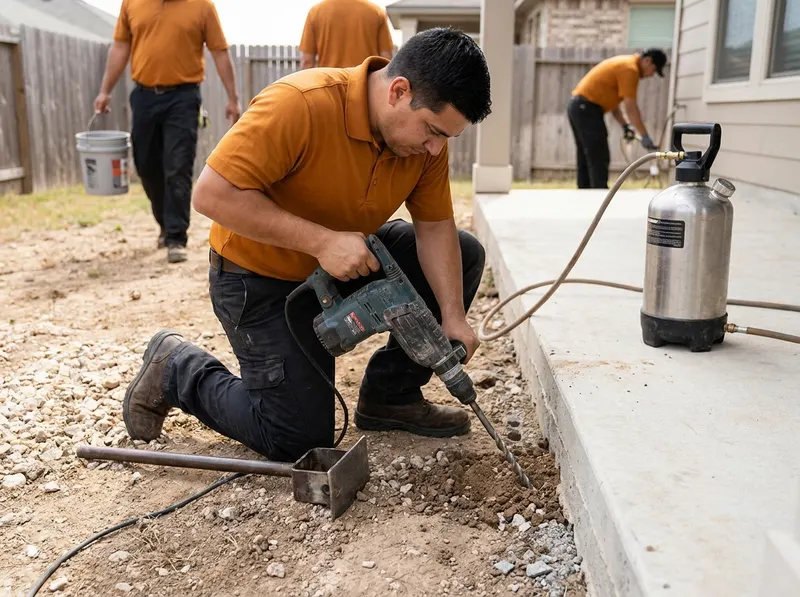
Installing a subterranean termite barrier requires physical modification of the soil zone immediately adjacent to exterior walls. Technicians dig continuous 6-inch by 6-inch trenches along the foundation perimeter, rod the trench floor to reach the footer depth, and inject measured volumes of termiticide before backfilling. Where concrete flatwork—such as driveways in Westover Hills, carports in the Medical Center, or covered patios in Alamo Heights—abuts the foundation, technicians drill vertical holes through the slab at 12-inch intervals, inject the protective barrier underneath, and seal every opening with non-shrink structural plugs.

What it costs

Perimeter Soil Trenching (Up to 150 Linear Feet)$850 - $1,450
Perimeter Trenching & Concrete Flatwork Drilling (150-250 Linear Feet)$1,450 - $2,400
Large Residential Perimeter & Pier-and-Beam Hybrid Defense (250+ Linear Feet)$2,400 - $3,800
Targeted Trenching Spot Defense & Inspection (Minimum)$250 - $450

Every job gets a firm, written price after a free on-site visit.

Common questions

How long does subterranean termite soil and slab trenching defense last in San Antonio?
A professionally applied non-repellent liquid termiticide barrier in San Antonio soil generally maintains effective structural defense for 5 to 10 years, provided the treated perimeter soil remains undisturbed by major landscaping or construction.
Is drilling through concrete patios required for termite trenching in San Antonio?
Yes, drilling through attached concrete slabs like porches, patios, and garage aprons is necessary in San Antonio structures to saturate the soil beneath the slab where subterranean termites enter foundation expansion joints.
Will trenching termiticides harm plants or pets in San Antonio yards?
Modern non-repellent termiticides bind tightly to soil particles once applied and backfilled into the trench, minimizing leaching and keeping active ingredients concentrated below ground where household pets cannot access them.
How does San Antonio clay soil affect termite trenching defense?
Heavy clay soils in areas like Southtown and the Medical Center hold liquid termiticide effectively, though careful trenching and slow hydraulic injection are required to prevent surface runoff and ensure deep penetration down to the foundation footing.
How fast does subterranean termite soil trenching stop an active infestation in San Antonio?
Soil trenching cuts off subterranean access immediately, and foraging workers exposed to the treated perimeter transfer the termiticide throughout the colony, eliminating active infestations within 30 to 90 days.

Ready to get started?

Tell us about your subterranean termite soil & slab trenching defense job in San Antonio and we'll send a clear, written quote — usually the same day.